Over the past year, many people have quietly changed how they shop online. Instead of searching, opening 20 tabs (or maybe that's just me?), comparing reviews, and weighing up options themselves, more people are starting to ask AI tools directly:
• “What’s the best option?”
• “Which one should I buy?”
• “Where should I go for dinner?”
Google is leaning hard into this behaviour with AI Mode and AI-powered shopping, where search feels less like a list of links and more like a conversation with a helper.
As a result, customers are starting to expect fewer choices, clear recommendations, and faster decisions - with less effort on their part.
Ecommerce’s main players are betting that people will increasingly delegate shopping decisions to their personal AI assistant, and that shift is why Google has introduced something called the Universal Commerce Protocol (UCP).
A simple way to think about it
Imagine walking into a huge shopping mall. Instead of browsing store by store, you’re greeted at the door by a very smart personal shopper and you say:
“I need a blue, women’s waterproof jacket for a trip this weekend, size M, under £150, delivered by Friday.”
That assistant already knows which shops are trustworthy, what’s actually in stock, who delivers quickly, and which products meet your brief. It doesn’t show you every possible option. It recommends the best few, explains why, and can take you straight to checkout.
That’s the direction Google is moving online shopping towards, and UCP is the system that makes it possible.
What is Google's UCP?
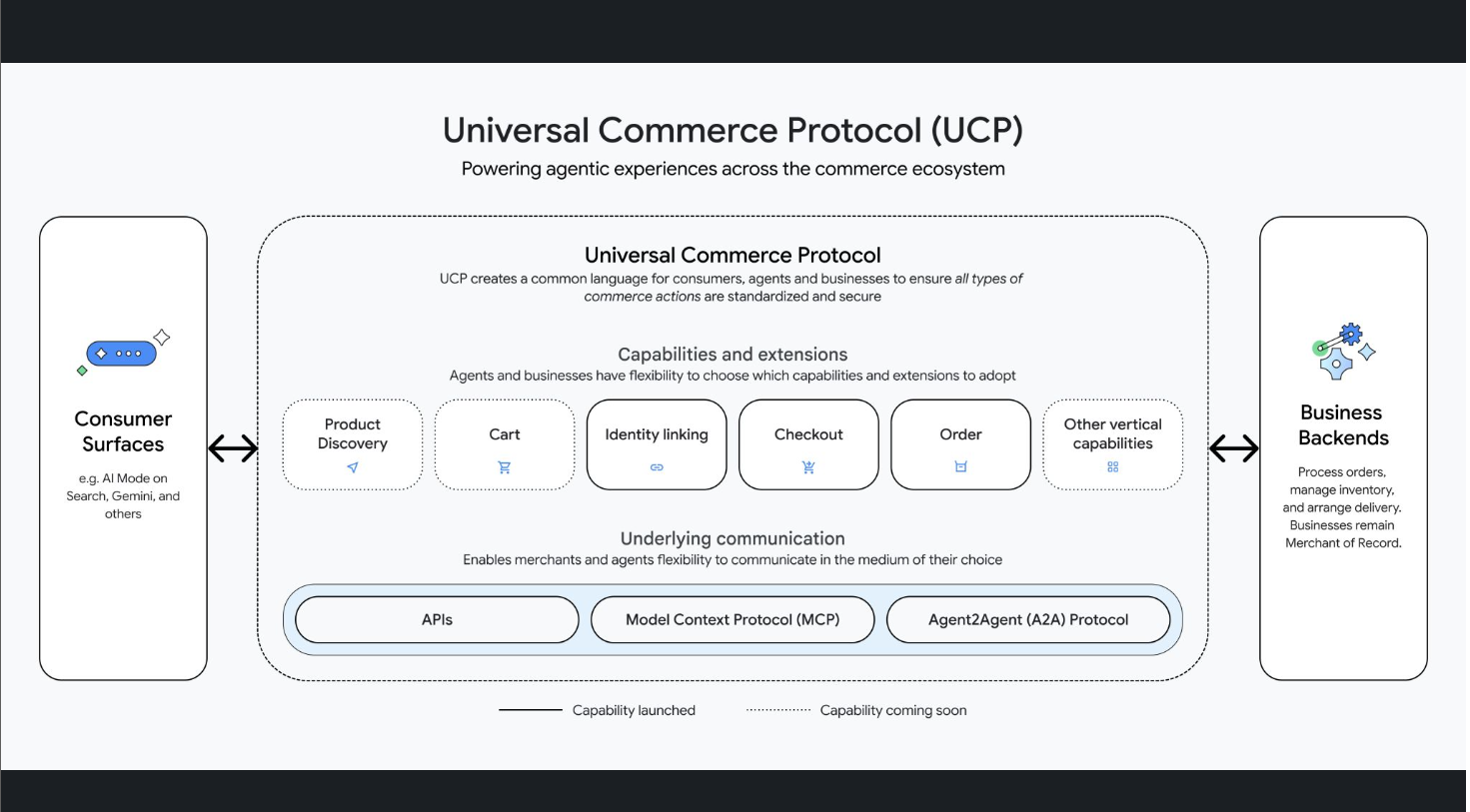
Universal Commerce Protocol is Google’s way of helping AI understand how businesses sell things. Think of it like standardised labelling in shops. It’s a shared set of rules that tells AI:
• What a product is
• How much it costs
• Whether it’s in stock
• How it can be delivered, returned, and purchased
Instead of websites being designed mainly for humans clicking around, UCP helps AI assistants:
• Understand what you sell
• Trust the information it’s using
• Handle recommendations and purchases confidently
If AI is the super-smart shopping assistant who greets you at the shopping centre, UCP is like giving every shop the same price tags, stock labels, delivery times, and checkout rules, all written in a language the assistant understands.
UCP doesn’t make AI smarter, it just makes product information clearer and more trustworthy. The AI shopping assistant knows what the customer wants but it can only recommend confidently if shops label things clearly.
This is what powers new AI-driven shopping experiences, where customers won’t have to search through a list of products to find the one they want. They can ask, compare, and buy through AI interfaces, including tools like Gemini, ChatGPT, and Google’s own AI Mode.
Why this matters for the future of online shopping
Traditionally, online shopping looked like this:
1. Someone searches for a product
2. Google shows a list of links or products
3. The user browses, compares, add to cart
4. They decide whether or not to buy
The emerging model looks more like this:
1. Someone asks an AI for what they need
2. The AI compares options instantly
3. It recommends a short list
4. It sends the customer straight to purchase
In this setup, AI becomes the “front of house”.
Your website still matters. You still fulfil the order. But, crucially, AI decides whether your product is appears on the list of options put in front of the customer. Now, this isn’t completely new. SEO has always been about visibility, and people have been optimising product pages to appear in search results for years. The difference now is that the goal shifts from ranking highly to being trusted enough to be recommended.
Where UCP fits into this
UCP is essentially the rulebook that lets AI handle shopping safely and accurately (something AI has historically had a bit of an issue with!).
It standardises things like product details, pricing, carts and checkout steps, orders, fulfilment, return policies etc. This means that when an AI recommends a product, it can be confident that it's recommending the right product, at the right price, and the retailer can fulfil the order.
For businesses, this reduces guesswork or the risk of ChatGPT telling someone that your £150 waterproof coat will cost them a mere £15. Instead of AI pulling information from inconsistent or unclear sources, it relies on structured, trusted data.
What this means for businesses (the important bit)
Of course, it remains to be seen how the take up will go (the current documentation utilises Google Pay – great for the Android users among us, but will it be so seamless for Apple’s OS?) and how paid ads will feature in the mix (you’d have to be very careful about showing paid ads when someone has asked for “the best” of something, for example) but one thing's for sure - it's on the way. And just as Google rolled out AI Mode in the US, AI shopping is being rolled out with “eligible US retailers” first, so many of us will have a bit of time to study the impact before it's action stations.
You don’t need to “get UCP" on your ecommerce site tomorrow, but it is worth preparing for a world where customers may never actually need to visit your site to buy from you.
So, what do you need to do?
Use structured product data
This is where your website platform or developer matters. Most ecommerce platforms (Shopify, WooCommerce, Magento, etc) already support the kind of structured product data AI relies on if it’s filled in properly, and these guys worked with Google on the creation of UCP.
• If you’re on Shopify or similar, keep your product data immaculate Complete all product fields. Don’t leave important info blank. Don’t hide key details in images or PDFs.
• Watch for platform announcements about UCP/agentic checkout support
• If you’re custom / enterprise, flag UCP to your dev/ecomm team as something to track and potentially implement
Be very clear about what you sell (and who it’s for)
AI struggles with vague messaging. Instead of:
“High-quality solutions for modern needs”
Aim for:
“Women’s waterproof hiking jackets, sizes 8–18, delivered next day in the UK”
Clear beats clever when it comes to AI.
Make your product information boringly accurate
AI loves boring accuracy. Check that prices are correct, stock availability is up to date, delivery times are honest and realistic, and returns policies are easy to find and understand.
If humans find it confusing, AI definitely will!
Build trust signals everywhere
AI is cautious. It prefers businesses that look legitimate and reliable. That means:
• Clear contact details
• Customer reviews
• Easily available policies
• Consistent branding and messaging
• No bait-and-switch pricing
Think of it like passing an AI version of a background check.
The big UCP takeaway
Google’s Universal Commerce Protocol isn’t replacing your website. It’s about teaching AI how to represent your business accurately when customers shop through AI-powered tools.
While it can be tempting to see this as another Google false start (anyone remember Voice Search being something we all needed to get ready for!?), the rise of AI search and the investment from Google makes this one that’s essential to listen to. Add to this, Google also announced the launch of Business agents, which will allow businesses to create branded chatbots that users can interact with directly within search results (again, rolling out with a small number of eligible sellers in the US for now), showing that they’re going all in with this one. But Business agents is one for another blog!
There are also some important considerations. Reporting remains unclear, a single AI-driven touchpoint may not suit brands built on storytelling, and OpenAI’s recent announcement of a similar protocol (ACP) introduces another variable into the mix. However, there's no doubt this is where tech giants like Google and OpenAI see the future of ecommerce. The businesses that win the battle to get their products seen and purchased won’t necessarily be those with the biggest budgets or the flashiest websites. They’ll be the ones that have clear, structured data that’s easy for the AI to understand, and the trust in the brand to justify the recommendation.
If AI is the new shop assistant, your job is to make sure it knows exactly what’s on your shelves and can recommend it with confidence.
1st Floor, Alphin Brook House,
Alphin Brook Road,
Exeter EX2 8RG
MORE THAN
Digital
Marketing.
View our sustainability page.
PPC for B2B
PPC for Law Firms
PPC for Luxury Ecommerce Brands
PPC for Travel and Tourism
GEO Audit