How mature is the average marketing function in 2026?
To find out, we've launched the Optix Marketing Maturity Assessment, benchmarking UK businesses across five key areas:
- Strategy & Planning
- Brand & Positioning
- Digital Presence
- Content & Engagement
- Measurement & Innovation
While the research is ongoing, we've analysed the first 30 responses and some clear patterns are already emerging.
The findings suggest that many businesses have ambitious growth goals, but their marketing capabilities may not yet be equipped to support them.
If you'd like to compare your own marketing maturity against the benchmark, you can complete the free assessment here: https://marketing-score.scoreapp.com/
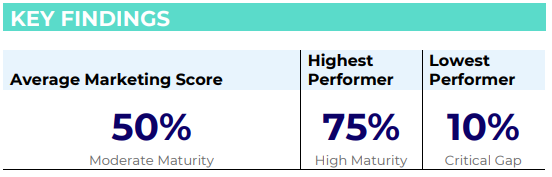
The average marketing maturity score is 50%
Across all respondents, the average Marketing Maturity Score was 50%.
This places most organisations firmly in the middle of the maturity scale.
Few businesses demonstrated highly mature marketing functions. Equally, very few scored exceptionally poorly. Instead, the majority sit in a position that is familiar to many marketing leaders: doing some things well, but lacking consistency across the board.
The challenge with moderate marketing maturity is that it can create a false sense of confidence.
Marketing activity is happening. Campaigns are being delivered. Content is being published. However, there are often gaps in strategy, execution or measurement that limit long-term performance.
Content is the biggest weakness
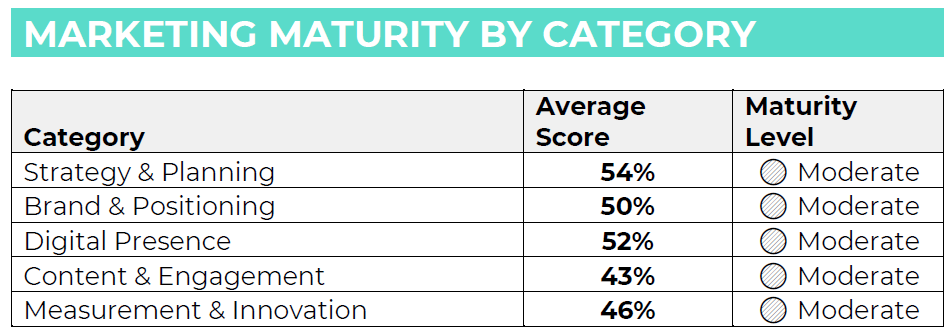
The lowest scoring category was Content & Engagement, with an average score of just 43%.
This was perhaps the most interesting finding in the benchmark.
Many organisations are investing in websites, paid media, social media and marketing technology. Yet they continue to struggle with creating consistent, high-quality content that demonstrates expertise and drives engagement.
Historically, this has been a problem. In 2026, it is becoming a risk.
As AI-powered search platforms such as ChatGPT, Gemini and Perplexity increasingly influence how buyers research suppliers, content is becoming one of the most important visibility assets a business owns.
The organisations that are most visible in AI search are rarely those producing the highest volume of content. They are the organisations publishing original insights, expert opinions, proprietary research and genuinely useful resources.
This is one reason we believe content maturity will become an increasingly important competitive advantage over the next few years.
Growth ambitions are outpacing marketing capability
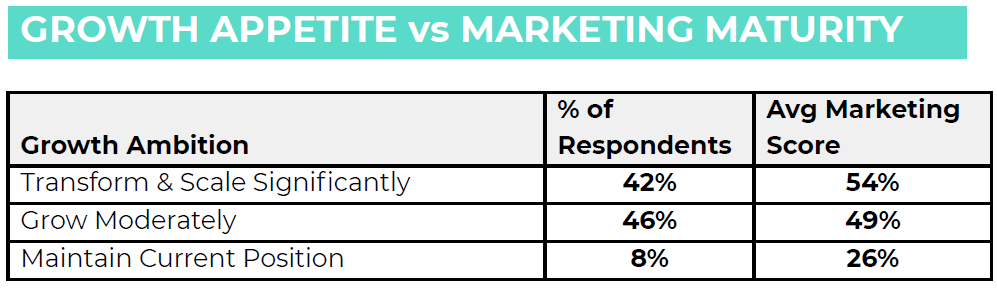
One statistic stood out immediately: 42% of respondents said they wanted to significantly transform and scale their business.
However, the average marketing maturity score within this group was only 54%.
This raises an important question: Can your marketing function realistically support the growth targets your leadership team has set?
Many organisations are looking for accelerated growth while operating with marketing systems that are only moderately mature. That doesn't necessarily mean spending more money.
In our experience, the biggest barriers are often:
- Lack of clear strategic direction
- Inconsistent content production
- Limited measurement frameworks
- Poor alignment between marketing activity and business objectives
The opportunity for many businesses is not simply to do more marketing. It is to improve the effectiveness of the marketing they are already doing.
Many businesses understand what to do but struggle to execute
Another interesting pattern emerged when comparing categories.
Strategy & Planning scored 54%.
Content & Engagement scored 43%.
This suggests that many organisations understand what good marketing looks like, but struggle to execute consistently.
Most marketing leaders already know they should be:
- Producing thought leadership content
- Building authority within their market
- Measuring performance effectively
- Maintaining a consistent presence
The challenge is finding the time, resources and capability to make it happen.
This gap between strategy and execution is often where growth starts to stall.
Measurement remains a blind spot
Measurement & Innovation achieved an average score of 46%.
While most organisations collect data, many still struggle to connect marketing activity directly to business outcomes.
This creates several challenges as teams find it harder to secure budget and senior leaders lose confidence in marketing performance.
Investment decisions become increasingly reactive.
As budgets come under greater scrutiny, businesses that can clearly demonstrate marketing effectiveness will have a significant advantage over those that cannot.
What these early findings tell us
Although this is still an early-stage benchmark, the results point towards a common theme.
Many organisations are ambitious.
Many are investing in marketing.
Many understand what good looks like.
But there remains a significant gap between ambition and capability.
As AI continues to reshape search, content discovery and buyer behaviour, that gap may become increasingly visible.
The businesses that invest in improving marketing maturity today are likely to be better positioned to build visibility, generate demand and achieve sustainable growth tomorrow.
How does your marketing function compare?
We're continuing to collect responses for the next edition of the benchmark and would love to include more organisations.
Complete the free Marketing Maturity Assessment to:
✓ Receive your personalised Marketing Maturity Score
✓ Benchmark your results against other UK businesses
✓ Identify your biggest opportunities for improvement
✓ Contribute to future benchmark research
The assessment takes around two minutes to complete and all responses are anonymised.
Take the assessment here: https://marketing-score.scoreapp.com/

1st Floor, Alphin Brook House,
Alphin Brook Road,
Exeter EX2 8RG
MORE THAN
Digital
Marketing.
View our sustainability page.
PPC for B2B
PPC for Law Firms
PPC for Luxury Ecommerce Brands
PPC for Travel and Tourism
GEO Audit